
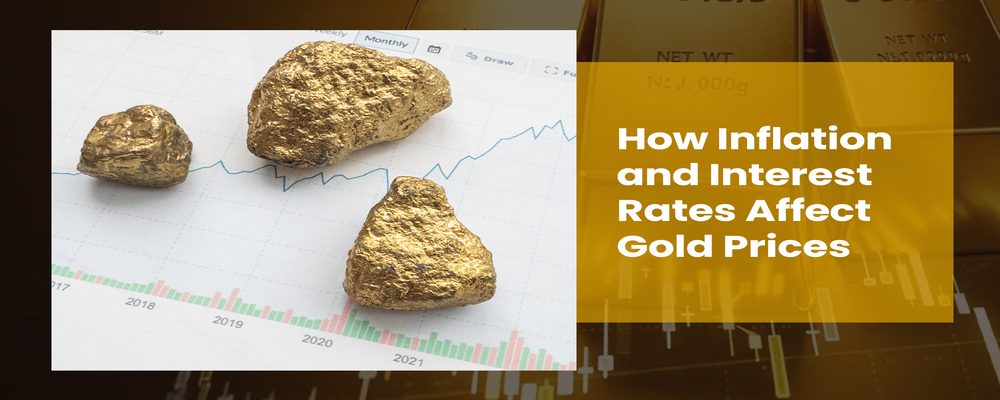

Read on to learn about inflation, interest rates, and everything that affects the price of your precious metals.
You’ve certainly heard about inflation, interest rates, and gold prices in the news. These three concepts are often brought up together but are seldom explained clearly. If that is something that interests you, or if you hold gold in the form of gold jewellery or gold bars that you hope to sell in the future, these concepts will be of great assistance to you.
Let’s dive in.
What Is Inflation?
Inflation is the increase in the cost of living over time. You experience this every day. Grocery prices are higher than they used to be. Fuel prices fluctuate. The costs associated with rent, energy, and educational institutions increase steadily. A take-away cup of coffee has become more expensive than it was a few years ago.
This implies that the purchasing power of money has diminished. The same piece of money can buy less than it did before. That’s inflation.
How Inflation Affects Gold Prices
When people notice the decreasing power of their money, they start looking for ways to protect its value by investing in precious metals like gold and/or silver. Gold has played the “safe-haven” role for generations.
Gold doesn’t depend on banks or governments. It doesn’t get printed, and its supply is limited. Because of that, people often trust gold more during uncertain times.
When inflation rises:
This is why gold is often called a safe haven asset. It’s something people feel comfortable holding when money feels uncertain.
What are interest rates?
Interest rates are what banks charge you to borrow money and what they pay you for saving money.
You will come across interest rates while
Whenever interest rates increase, loan repayments increase. Whenever they scale down, borrowing becomes cheaper. The adjustment of interest rates by governments and central banks is usually made to control inflation and stabilise economic uncertainties.
How Interest Rates Affect Gold Prices
Gold doesn’t earn interest. So when interest rates rise, savings accounts and term deposits become more attractive.
Here’s how that affects gold:
-
Higher interest rates can slow gold demand
-
Some people move money into savings
-
Gold prices may level out or dip slightly
However, there’s an important detail here that you should not miss.
If inflation is higher than interest rates, money in the bank is still losing value. This is why gold often remains attractive even when rates rise slightly. This gap is what people mean when they talk about real interest rates, but you don’t need to overthink it.
In simple terms, if savings don’t keep up with rising prices, gold looks like the safest bet.
When Inflation and Interest Rates Change Together
Inflation and interest rates tend to move together; however, they do not necessarily move at the same pace. This is where gold prices are affected.
-
When inflation is high and interest rates are low in countries, gold prices tend to rise.
-
A high rate of inflation and subsequent interest rate hikes could hold back an increase in gold prices.
This is why the price of gold does not follow a straight line. Gold reacts to confidence, trust, and value.
Gold Jewellery vs. Gold Bars During Inflation
Before looking at how inflation affects gold, it helps to understand the difference between gold jewellery and gold bars.
-
Gold jewellery includes rings, chains, bangles, earrings, and necklaces. However, pure gold cannot be worn; therefore, it must be mixed with other metals to make it stronger and more durable. That is why you won’t see any pure gold jewellery; rather, it is either 14K or 18K gold jewellery. In selling jewellery, only the intrinsic value matters, and not its design or the emotion attached to it.
-
Gold bars and gold coins, also known as bullion, are intended solely for investment. They are not designed to be worn or used. Most bullion is made from 24K gold, which is almost pure gold. Gold bars and gold coins are easy to value because of their standard weights and gold content.
Now, let’s look at what happens during inflation.
When inflation rises, gold prices usually go up. Gold bars and coins tend to follow market prices very closely, so their value increases almost in line with the gold price you see online.
Gold jewellery also increases in value, but at a slower rate per gram. This is because it contains less gold and must be refined before it can be reused.
So while both jewellery and bullion benefit when gold prices rise, bullion responds faster and more directly, and jewellery still gains value, just a little more gently.
What This Really Means for Everyday Australians Who Own Gold
Gold prices fluctuate from time to time, but that doesn’t necessarily imply that you have to respond to the changes. Gold is not a get-rich-quick type of investment. It is something people actually keep for stability. When you think in that way, you clearly understand the concept of inflation and its relation to buying gold.
Here’s how this knowledge will help you in real life:
-
You understand why gold prices move up and down, as opposed to guessing or worrying about that.
-
You may decide that a price increase is worth waiting for, or not, and choose not to sell.
-
You don’t engage in panic selling merely because stock prices temporarily go down
-
You are more confident in speaking with trusted gold buyers in Brisbane.
Just remember this: gold is valuable over time. That slight price drop won’t wipe away its value for tomorrow. When you look at long-term changes in gold prices instead of everyday price changes, you make wiser investment decisions.
Final Thoughts
You don’t need to watch the markets every day to understand gold. Knowing the basics is enough. If you own gold and are thinking about selling, the proper knowledge helps you feel confident and prepared.
At Cash Your Gold, fairness comes first. Every item is tested carefully, weighed in front of you, and priced using live market rates. There are no hidden deductions and no confusing explanations. You’re told exactly how the value is calculated, so you know what you’re being paid for and why. Once you’re happy, payment is made on the spot as instant cash or via bank transfer.
To know more about the value of your gold,
📞 Call: 1300 678 175
Or Visit
1. Chermside (North Brisbane)
-
Address: Suite 5, 832 Gympie Rd, Chermside, QLD 4032
-
Phone: 07 49 390 234
-
Email: info@cashyourgold.net.au
-
Hours: Mon–Fri: 9:00 AM – 5:00 PM; Sat: 10:00 AM – 4:00 PM
-
Details: Located opposite Westfield Chermside, with parking available behind the building and easy access via Hamilton Road.
2. Sunnybank (South Brisbane)
-
Address: 6/409 Mains Rd, Macgregor, QLD 4109
-
Phone: 07 2142 6862
-
Email: info@cashyourgold.net.au
-
Hours: Mon–Fri: 9:00 AM – 5:00 PM; Sat: 10:00 AM – 4:00 PM
-
Details: Conveniently located in the heart of Sunnybank, easily accessible for residents.
3. Brownsplains (South-West Brisbane)
-
Address: Unit 3/3376 Mount Lindesay Hwy, Regents Park, QLD 4118
-
Phone: 07 2142 6482
-
Email: info@cashyourgold.net.au
-
Hours: Mon–Fri: 9:00 AM – 5:00 PM; Sat: 10:00 AM – 4:00 PM
-
Details: Situated along the Mount Lindesay Highway, this location serves the south-western suburbs of Brisbane.
