
News Algos in Trading: Why Markets Suddenly Spike on Headlines
Anyone trading during the current geopolitical crisis has likely noticed sudden spikes and dips appearing out of nowhere, leaving traders asking the same question: What’s the news?
As traders know all too well, it is often the reaction to the news rather than the news itself that matters most. Sometimes the market’s response is logical. Other times it seems completely irrational. When that happens, traders can feel like they are the only sane person in an insane asylum.
The Trading World Has Changed
In the past, traders who had access to expensive institutional news feeds had a major advantage. Getting market-moving information even a few seconds earlier than others could provide an edge.
Today, many traders have access to live news feeds, but the advantage still goes to the early bird. The difference is that the early bird is no longer a trader, it is news algorithms, often called news algos.
What Are News Algos in Trading?
News algos are automated trading programs designed to scan news feeds, interpret headlines, and react to economic data releases in milliseconds.
Their objective is simple: identify market-moving news and execute trades faster than human traders. This speed advantage makes it extremely difficult for discretionary traders to compete with algorithms on the initial market reaction.
Instead, many experienced traders allow the algos to react first and then assess whether the market’s reaction is logical or whether the move has been exaggerated.
Who Uses News Algos?
News algorithms are primarily used by large institutional trading firms, including:
- Hedge funds
- Proprietary trading firms
- High-frequency trading firms
These firms attempt to capture short-term price movements immediately after economic releases or breaking headlines, often before human traders even have time to read the headline.
How News Algos Work
News algos combine natural language processing and super-fast access to data feeds to analyze information almost instantly and determine whether the news is bullish, bearish, or neutral for a specific market.
Here is a simplified version of the process.
- Headlines Hit the News Feed
Breaking headlines are distributed through professional news services such as Reuters or Bloomberg.
- The Algo Scans the Headline
The algo instantly scans the headline and compares it with previously defined keywords and models that evaluate sentiment
- Market Impact Is Assessed
The system determines whether the news is bullish or bearish for a particular market, such as a currency, stock index, commodity, or bond.
- Trades Are Executed
If the headline meets the algo’s criteria, trades are executed automatically.
The entire process can occur in less than a millisecond.
Why News Algos Matter to Traders
For retail traders in particular, understanding how news algorithms operate explains the sudden moves that often occur immediately after economic data or headline news, ometimes before the news even appears on their own feeds.
This is why traders frequently see:
- Large candles forming within seconds, often with long wicks
- Sudden gaps in liquidity
- Rapid reversals after the initial reaction
- Slippage when brokers execute stop-loss orders
These moves are often the result of algos reacting instantly to headlines.
Why Can’t I Compete With the News Trading Algos?
News Algos Are Far From Foolproof
Just because algorithms lead the initial reaction to a headline does not mean they always get it right. Far from it.
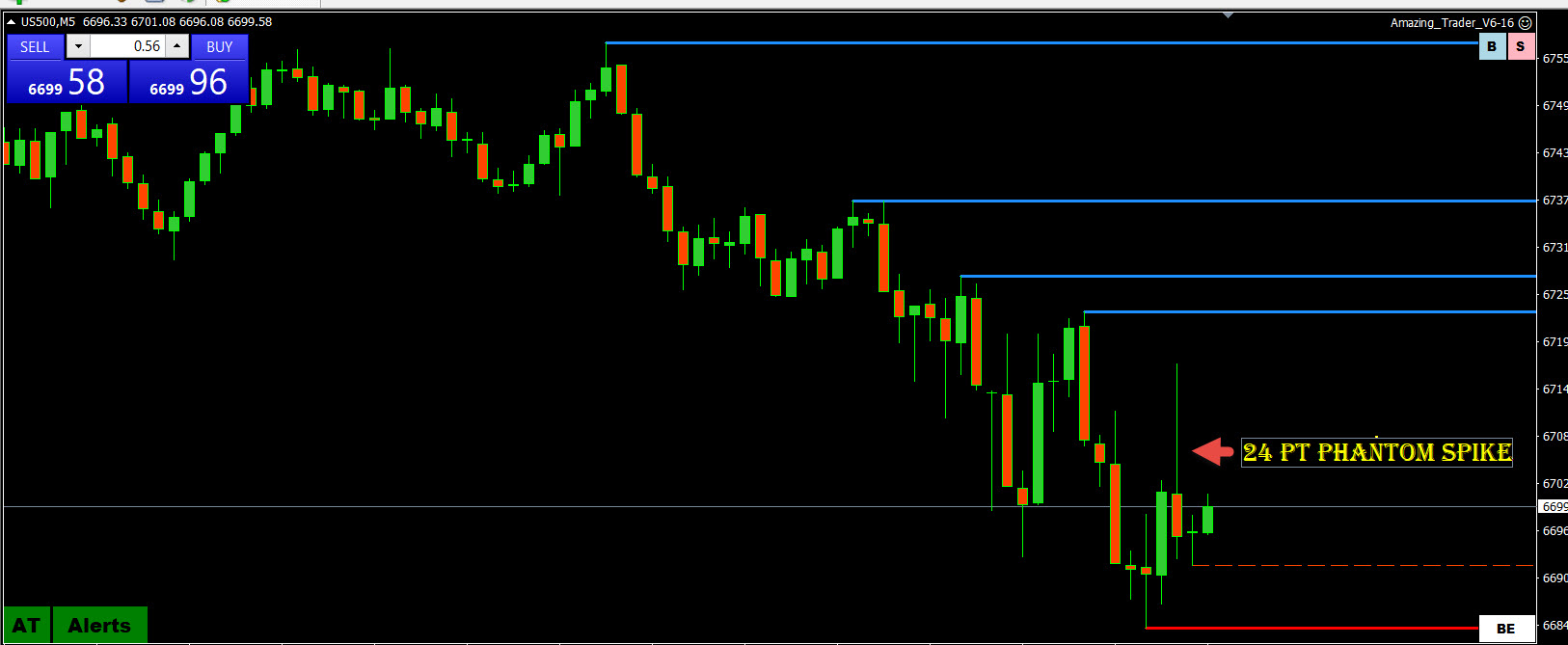
Because many algos rely heavily on keyword recognition without fully understanding context, they can sometimes misinterpret the news. When that happens, markets can experience what some traders refer to as phantom moves, sudden spikes or drops that are quickly reversed.
US500 24 point “phantom” spike

A Recent Example
A recent example occurred following comments from President Donald Trump on March 9 suggesting that the war with Iran could end soon.
News algos reacted immediately. U.S. equities reversed earlier weakness, never looked back, and climbed steadily throughout the day.
However, in the days that followed, markets began to reassess the situation as traders considered the broader geopolitical reality.
To sum up, traders thrive on volatility because it creates opportunity. Understanding what drives the initial market reaction can help traders navigate that volatility more effectively.
In many cases, the first move after a headline or economic release is driven by news algos reacting to information faster than humans.
The key is recognizing that while algorithms often drive the initial spike, the subsequent moves are typically driven by human traders reassessing the news.
For traders attempting to fade an algo-driven move, it is worth remembering the old market adage:
A market can remain illogical longer than you can remain solvent.
