

Brent vs WTI
Oil Price
The global oil market has entered a highly event-driven phase, leaving traders questioning whether Brent or WTI crude should serve as the primary benchmark. Traditionally, Brent crude has been viewed as the global pricing standard, while WTI has reflected U.S. domestic conditions. However, recent geopolitical and supply dynamics have blurred these distinctions, making the choice far less straightforward. With the price of oil driving all global markets, choosing the benchmark to follow is important for all global traders.
Oil Price
The initial driver of the widening spread between Brent and WTI was rooted in Middle East supply disruption. Following the onset of conflict and the effective closure of critical transit routes such as the Strait of Hormuz, global supply concerns intensified. Brent crude, which is more exposed to international shipping routes, surged sharply due to heightened geopolitical risk. In contrast, WTI remained relatively insulated, as the United States is less dependent on oil flows through these constrained channels. This divergence caused Brent to trade at a significant premium over WTI.
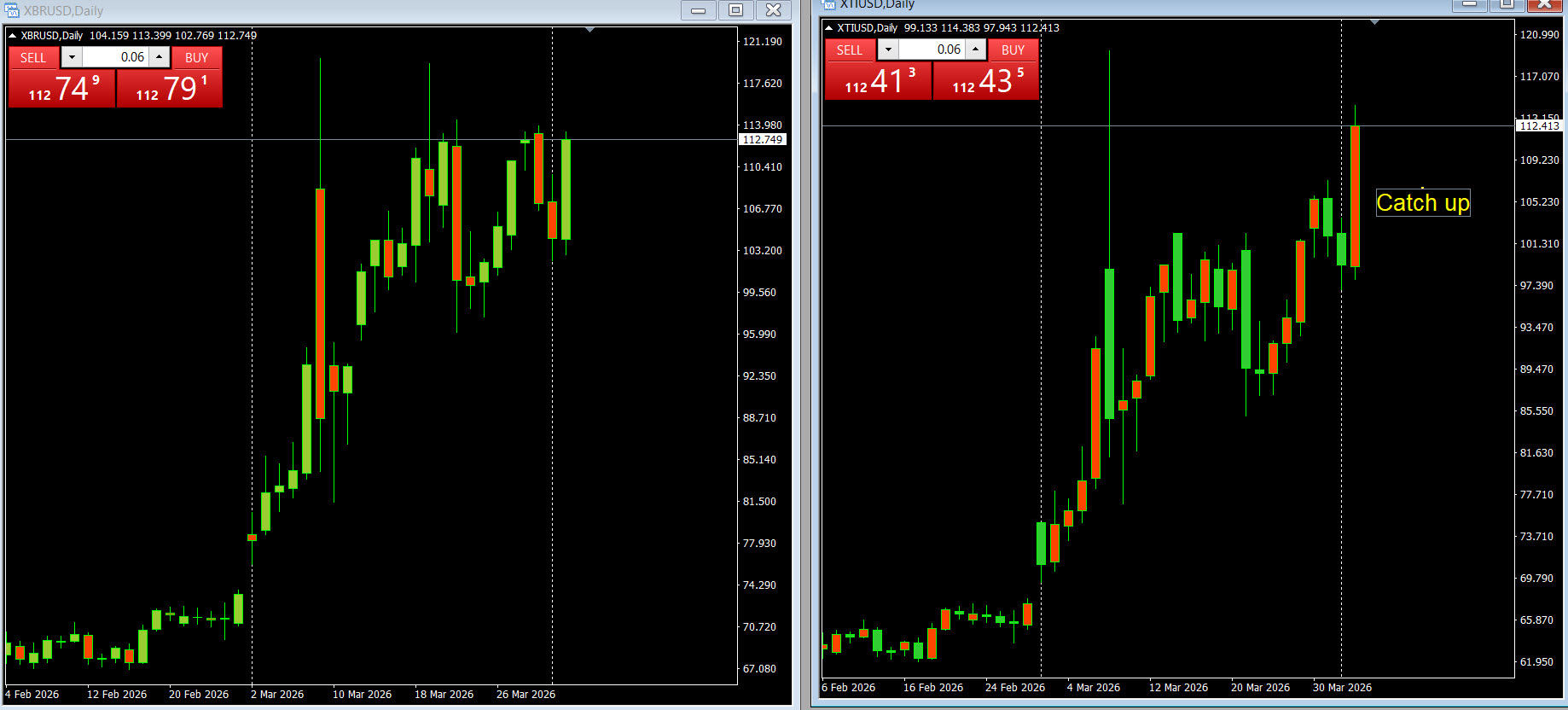
That premium, however, has since collapsed. As global buyers sought alternatives to disrupted Middle Eastern supply, U.S. crude exports surged. Tanker flows increasingly shifted toward the U.S. Gulf Coast, where WTI-linked crude became a viable substitute. This influx of demand pushed WTI prices higher, effectively narrowing the spread between the two benchmarks. The market began to treat U.S. oil not as a regional commodity, but as a global one.
At the same time, the market experienced a sharp spike in backwardation, signaling an immediate supply squeeze. Strong demand for prompt physical delivery drove front-month futures significantly higher for both Brent and WTI. However, WTI reacted more aggressively due to its accessibility and role as an alternative supply source. This intensified price movement further contributed to the rapid collapse of the spread.
Oil Price
XTIUSD (WTIUSD) DAILY XRBUSD (BRENT) DAILY

Another critical shift is the evolving perception of U.S. crude oil. In the current environment, buyers are less concerned with traditional benchmark relationships and more focused on securing available supply. As a result, WTI has effectively transitioned into a globally relevant pricing mechanism. This transformation has tightened its correlation with Brent and reduced the structural differences that once defined the two benchmarks.
Meanwhile, Brent is facing emerging headwinds despite ongoing geopolitical support. Elevated prices are raising concerns about demand destruction, particularly in price-sensitive economies. Additionally, the potential release of strategic petroleum reserves could introduce additional supply into the market. Rather than Brent declining significantly, the adjustment has largely occurred through WTI catching up.
Geopolitical Crisis and Market Impact: Oil, Inflation, and Safe-Haven Flows in Focus
In summary, the oil market has undergone a rapid recalibration. What began as a Brent-driven price shock has evolved into a broader market adjustment where WTI has risen faster, erasing the previously wide spread. For traders, this creates both clarity and uncertainty. If the spread remains compressed, the distinction between Brent and WTI becomes less critical, allowing either benchmark to guide trading decisions. However, if divergence re-emerges, the leading benchmark will once again dictate global market direction.
Ultimately, in a market defined by geopolitical risk, supply constraints, and shifting trade flows, adaptability is key. Traders must monitor not just price levels, but also the evolving relationship between Brent and WTI to determine which benchmark truly reflects the pulse of the global oil market.
Oil Price
